
Accepting Suffering with Love
Translated from the Hebrew original.
This week is dedicatedWould you like to dedicate this week's Torah? Dedicate

A story about Rav Yoram
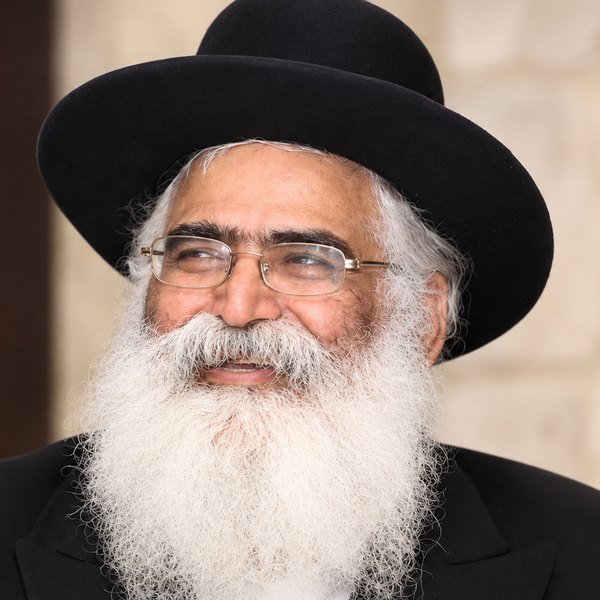
The face of our father and teacher, Rav Yoram Abergel zy”a, always beamed with a pure joy that spread light to everyone around him. It would have been easy to think that Rabbeinu was free of worries and burdens; but from even a small glimpse at the great number of troubles of the people of Israel that came knocking at his doors – and he would take them under his protection with a compassionate love, like that of a father for his children – one can immediately understand the many burdens that rested on his shoulders. If so, how was Rabbeinu able to keep his joy despite everything?
Rabbeinu testified about this: “I remember from the days of my childhood that although my dear parents went through many sufferings of hardship and poverty and many illnesses, nevertheless no complaint ever came out of their mouths, Heaven forbid, about the deeds of the Creator Yitbarach. Rather, they would always say that whatever Hashem does is surely good. And with all the sufferings that passed over them, they always showed a shining face to every person and radiated joy toward those around them; they did not show their pain outwardly but hid it in their hearts.”
This is what Rabbeinu absorbed: to rejoice in everything that Hashem gives us, for it is the perfect good for us. And this is what he bequeathed to us, his students.
On the greatness of giving thanks to Hashem for all His goodness, Rabbeinu spoke in the book “Imrei Noam” on Parashat Vayigash
Further on in the parasha it is told that when Yaakov Avinu came before Pharaoh, Pharaoh asked him what his age was, and Yaakov answered him that his age was a hundred and thirty, and that throughout all these years he had only suffered harsh and bitter sufferings and had not merited the great good that his holy forefathers had merited. In the words of the verses: “And Pharaoh said to Yaakov: How many are the days of the years of your life? And Yaakov said to Pharaoh: The days of the years of my sojournings are a hundred and thirty years; few and evil have been the days of the years of my life, and they have not reached the days of the years of the life of my fathers in the days of their sojournings” (Bereshit 47:8–9).
It is written in the commentary “Daat Zekenim of the Baalei HaTosafot” that because Yaakov Avinu complained that throughout all the days of his life he had seen only evil and sufferings, Hashem punished him and reduced the allotment of life that was fitting for him by thirty-three years – corresponding to the number of words he said in his complaint. In the holy language of the Baalei HaTosafot:
Midrash: When Yaakov said “few and evil have been,” Hashem said to him: I saved you from Esav and from Lavan, and I returned Dina to you, and Yosef as well, and you complain about your life, that it is few and evil?! By your life, the number of words from “And he said” until “in the days of my sojournings” – so many shall be lacking from your years, that you shall not live as long as the life of Yitzchak your father. And they are thirty-three words. And by this number his life was diminished, for Yitzchak lived a hundred and eighty years, and Yaakov lived only a hundred and forty-seven.
However, seemingly one must reflect on this: if we carefully count the words that Yaakov said (“And Yaakov said to Pharaoh: The days of the years of my sojournings are a hundred and thirty years; few and evil have been the days of the years of my life, and they have not reached the days of the years of the life of my fathers in the days of their sojournings”), we will find only twenty-five words. Only when we add to this Pharaoh’s question as well (“And Pharaoh said to Yaakov: How many are the days of the years of your life?”) do we find thirty-three words.
If so, it would have been fitting for Hashem to reduce Yaakov’s years of life by only twenty-five years – corresponding to the number of words that he said. Why did Hashem reduce his years of life by additional years corresponding also to the words of Pharaoh’s question?
The claim against Yaakov was that his sufferings were evident in his outward appearance
To explain this, let us preface with the words of the Ramban, in his holy language:
It seems to me that Yaakov Avinu was touched with gray hair and looked very old, and Pharaoh wondered at his old age, for most people of his time did not live so long, as their years had already been shortened. Therefore he asked him: “How many are the days of the years of your life?” – for I have not seen anyone as old as you in all my kingdom. Then Yaakov answered that his days were a hundred and thirty years, and he should not wonder at them, for they are few compared to the years of his fathers, who lived longer; but because they were evil, with toil and sighing, he was touched with gray hair and looked very old.
That is to say: Pharaoh did not ask Yaakov his age just like that; rather, something caused him to ask it. Yaakov’s outward appearance – the hair of his head and his beard, white as snow – gave him the appearance of old age, much more than Pharaoh was accustomed to see. Because of this Pharaoh was aroused and asked Yaakov: “How many are the days of the years of your life?” – are you perhaps several hundred years old?!
And Yaakov Avinu answered him: I am relatively young; the days of the years of my life have not reached the days of my fathers; and the fact that I look old is because of the hard events that have passed over me.
According to this, the Rosh Yeshiva, the holy Gaon Rabbi Chaim Shmuelevitz ztz“l, resolves our question in a wondrous way:
The main claim against Yaakov Avinu was: why did you sense and feel that the events that passed over you were hard?! At so high a level as yours, you should not have felt any pain!
At a level as high and exalted as yours, you should have sensed that everything Hashem does with you is only good. Only good!
And since Yaakov felt a little bad (relative to the greatness of his level), it affected his outward appearance, and that is what caused Pharaoh’s question.
The outward appearance of Yaakov Avinu – which was created by his feeling – is what caused Pharaoh to ask about his age; therefore he was punished for the question as well!
And since there were eight words in Pharaoh’s question, Hashem reduced Yaakov Avinu’s years of life also by the number of words that Pharaoh said in his question.
A person is obligated to thank Hashem for the kindness of life, and thus he will not feel the sufferings
In this connection, Rabbi Chaim Shmuelevitz ztz“l mentions within his holy words what is said: “Why should a living man complain?” (Eicha 3:39), as well as Rashi’s explanation of this verse: “Why should a living man complain – why should a person grumble about the events that come upon him, after all the kindness I do with him, that I gave him life and did not bring death upon him?” And from this he learns a wondrous lesson, in his holy language:
After the kindness that a person receives from the Creator, which is life itself, how can he grumble about all the events that come upon him? It is like a person who won the grand prize in a lottery, and at that very moment his jug or his barrel broke – does he feel the small sorrow at the time of the great joy?! Surely the happiness that has fallen to his lot swallows up and nullifies all the petty feelings of sorrow that come upon a person in everyday life.
So a person must feel the kindness of Hashem, Who gives him life. His joy and his happiness should be without end or measure, until he does not sense or feel all the events that come upon him. And even great and tremendous sufferings, like the sufferings of Iyov, will be considered as nothing and naught compared to the feeling of happiness in life itself.
From the fact that, because of Yaakov Avinu’s lack of joy in the very gift of life that Hashem gave him, Hashem reduced by many years the allotment of life that was fitting for him, Rabbi Chaim further learns: Moreover, a person who does not properly appreciate the happiness of life may lose it entirely.
From all that has been said we must learn how obligated we are to rejoice in the many good things that Hashem in His mercy has given us – and above all, in the gift of life that Hashem has given us, for there is no gift more precious than it. And we must thank Hashem Yitbarach for this every single day and every single hour.
Weaning oneself from needless sighs
A person must sit with himself every single day and contemplate the good things that Hashem has given him, and draw great joy from this. Baruch Hashem he is alive; and in addition he has also merited to be healthy; and in addition he has also merited to marry a good wife and to bring precious and wonderful children into the world; and in addition he has also merited to live in a private home of his own; and so many, many more good things that Hashem has done with him – as we say in prayer:
“Were our mouths as full of song as the sea, and our tongues of joyous singing as the multitude of its waves, and our lips of praise as the breadth of the firmament; were our eyes shining like the sun and the moon, and our hands spread out like the eagles of the heavens, and our feet as swift as deer – we would still not be able to thank You, Hashem our God, and to bless Your Name, our King, for even one of the thousand thousands of thousands and myriads of myriads of times of good, miracles and wonders that You have done with us.”
If so, how can it be that instead of sitting and thanking Hashem all day long for all the good He has bestowed upon him, a person sits and all day long only sighs, complains and grumbles about his situation, and falls into terrible sadness? This is outright ingratitude toward Hashem, Who has done and does so much good for him!
One must thank Hashem in every situation, and in this merit he will be saved from all sufferings
Even when a person goes through a period that is truly not simple – for example, his health is shaky, or he is in a difficult financial situation, or he is going through difficulties in raising his children, and the like – even so, he should accept all the sufferings that come upon him with love and with joy, and not show those around him even a trace of all that he is going through, in the way of a chassid, whose “joy is on his face and his mourning is in his heart.”
And when Hashem sees his joy despite the sufferings that visit him, He will say: “This person is suffering greatly, and nevertheless he does not complain or grumble, but accepts everything with love and with joy, and shows a shining face to everyone, as if everything with him is perfectly fine. Therefore I will see to it that everything with him will truly be perfectly fine.”
A story is told of a certain wealthy man who, despite his great wealth, was also a Torah scholar. Every time this wealthy man completed a tractate, he would come to the holy Rebbe Dov Ber, the Maggid of Mezritch zy“a, to tell him about it and to receive his blessing to succeed in the study of the next tractate.
On one occasion, after the wealthy man had completed Tractate Berachot, he came as was his custom and told the Maggid about it; but this time he also added a question: “In this tractate I came across the saying of Chazal, ‘A person is obligated to bless over the bad just as he blesses over the good,’ but I have not succeeded in understanding how this is possible. After all, the reality is that when a person earns a handsome sum of money he is very happy, whereas when he loses a handsome sum of money he is very sad. I would like the honored Rav to explain to me how it is possible to rejoice in both situations in truly the same measure.”
Instead of giving him an answer to this, the Maggid said to him: “In truth, there is only one person in the world who can explain this to you in the most perfect way. That person is my dear student, Reb Zusha, who lives in the town of Anipoli. Travel to his house, and there, with Hashem’s help, you will find what you seek.”
The wealth of Reb Zusha of Anipoli
The wealthy man traveled to the town of Anipoli. To his great surprise, when he asked the townspeople to direct him to the house of Reb Zusha, they all pointed him to the dilapidated hut at the edge of town. If the wealthy man thought that he had ever in his life seen what poverty is, when he arrived at Reb Zusha’s house it became clear to him beyond any doubt that he had never yet seen poverty in his life.
Reb Zusha’s living conditions were truly appalling. His dilapidated hut had not yet collapsed on its inhabitants only by a true miracle. Rainwater leaked into it in every corner. Reb Zusha’s wife and children went about the house dressed in torn clothes. The floor of Reb Zusha’s house served both as a table at the time of eating the meager meals and as a bed at the time of sleeping at night. But nevertheless, the face of Reb Zusha, and likewise the faces of his household, beamed with happiness, as if there were none as wealthy as they in the whole world.
After all that the wealthy man’s eyes had seen, there was no longer any need to convince him that Reb Zusha was a man of sufferings without equal. All that remained for the wealthy man to do was to tell Reb Zusha the reason for his coming and to put his question to him: “How does the honored Rav succeed in being so joyful and happy despite the many sufferings that surround him on every side, and in fulfilling with great beauty the saying of Chazal, ‘A person is obligated to bless over the bad just as he blesses over the good’?”
But when Reb Zusha heard this, he raised both his eyebrows in great astonishment and said: “I do not understand at all why the Maggid sent you specifically to me. Surely he should have sent you to someone who has gone through, or is going through, pain and sufferings. But as for me – there is no one happier than I in the world. I have never tasted the taste of pain and sufferings. Baruch Hashem, all the members of my household are healthy. Our livelihood is available to us in abundance. We truly lack nothing. How, then, can I teach you how to accept sufferings with love?”
The wealthy man needed no further explanation. He returned to his splendid carriage full of shame and embarrassment. “After I have seen what Reb Zusha is going through, and nevertheless he is entirely full of joy and thanksgiving to the Creator of the world for all the ‘good’ He has bestowed upon him – can I even think of complaining and grumbling about my situation after all the wealth and honor that Hashem has given me?!” he thought in his heart. From that day on the wealthy man was filled with great joy, and did not stop thanking Hashem Yitbarach for His abundant kindnesses to him for even one moment.
We are not owed anything
The inner point of this story is: the wealthy man felt that he was worth something and that he was owed something. Therefore every time he lacked anything, even the smallest thing, he was caused pain and sadness fell upon him. Reb Zusha, by contrast, always felt that he was worth nothing and that he was owed nothing. Therefore, for every good thing that Hashem did with him, even the smallest, his heart was filled with feelings of joy and thanksgiving to the Creator of the world without limit.
And so it is with regard to each and every one of us: when we merit to truly understand and feel that we are worth nothing and that we are owed nothing, from that moment joy will not cease from us for even one moment.
In brief
a. Years were taken from the life of Yaakov Avinu corresponding to his complaining before Pharaoh.
b. The claim against Yaakov, according to the greatness of his level, was that his sufferings were evident in his outward appearance.
c. A person is obligated to thank Hashem for the kindness of life, and thus he will not feel the sufferings; and likewise we must rejoice in the many good things that have been given to us.
d. A person must thank Hashem in every situation, and feel that he is worth nothing and is owed nothing; and in this merit he will truly be saved from all sufferings.